September 5, 2022
Last Updated on September 5, 2022
The Health and Social Care Secretary has recently announced a new 10-year plan to tackle dementia and boost funding into research to better understand neurodegenerative diseases. It is planned that the actions will explore how technology, science and medicine can help reduce the rates and severity of dementia.
For World Alzheimer’s Month, Gavin Bashar, UK Managing Director at Tunstall Healthcare, discusses best practice in care for people living with Alzheimer’s, what the latest technology looks like, and how technology can be deployed to support people living with all forms of dementia.
Technology and the future of care
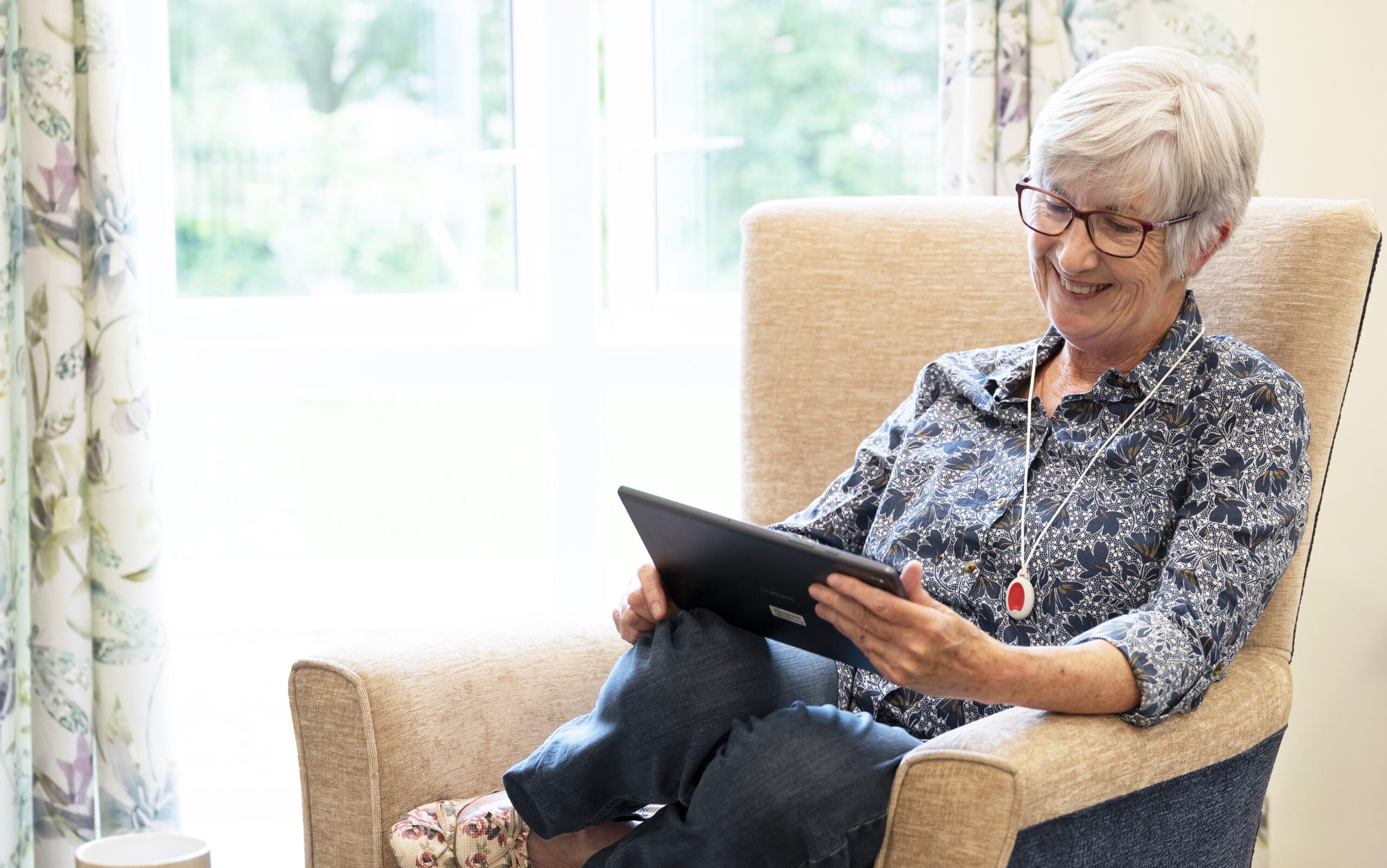
Technology plays a huge part in everyday life, with most of us using smartphones, smart speakers and a whole host of other devices which aim to make life easier. These pieces of technology save us time and effort with daily tasks, and they can also be of great benefit to the 900,000 people living with dementia in the UK.
Many care providers are already using technology, with digital care planning systems becoming more commonplace. However, the range of equipment which can support the health and care of people living with Alzheimer’s and other dementias is often less well known, even though these systems and solutions continue to revolutionise care provision. We are seeing more creative and innovative technology being used in the care of people living with Alzheimer’s, both at home and in residential care settings. For example, technology such as telecare is ever-evolving and is becoming more person-centred and intuitive, enabling formal and informal carers to deliver the right care at the right time.
The latest advanced care assist systems are created for people, not buildings, and take a completely new approach to call systems for care homes and care homes with nursing. Receivers and beacons that interact with smart pendants worn by service users can be placed around a building and have the ability to pinpoint the exact location of an individual in need, as well as the nature of the call. These systems can be managed by caregivers via a mobile app and ensure the safety of vulnerable people by enabling prompt responses to events such as falls. They also support a least restrictive approach, for example bed and chair occupancy sensors can enable residents to enjoy more privacy but with the knowledge that carers will be alerted should the sensor indicate they have left their chair or bed where this might present a risk.
The next generation of cutting-edge, data-driven technology that is being developed will be able to not just respond to incidents but to identify changes in behaviour that may indicate a deterioration in wellbeing and enable early intervention. For example, increased use of the bathroom could indicate a UTI, where a timely response with antibiotics could prevent hospital admission. Data will be taken from multiple sources, including motion sensors, smartphones, wearables and recordings, to provide a clear picture of the risks someone faces and alert their caregivers to respond if necessary. Such early intervention can improve quality of life, as well as helping to avoid the need for more complex care and enable health and care resources to be targeted where they are needed most.
Cutting edge research
Government has committed to doubling research funding for dementia to £160m a year by 2024, and new research continues to be released investigating how technology can innovate care for people living with dementia and Alzheimer’s.
For example, in 2018 Alzheimer’s Research UK joined forces with Deutsche Telekom, University College London and the University of East Anglia and developed a smartphone game to collect data on users’ spatial navigation. The study is ongoing but it continues to provide a greater understanding into the problems that can develop with orientation and spatial awareness in people living with Alzheimer’s. The findings will go towards supporting improved care provision, particularly when it comes to events such as falls which can take place due to a decline in spatial awareness.
An ongoing study is also currently underway which is investigating the accuracy and validity of remote monitoring technologies in measuring functional decline in a real-world environment for people living with Alzheimer’s. It is hoped that the findings of the study will give us greater insight into how technology can revolutionise care provision for people living with Alzheimer’s.
We must keep up to date with cutting edge research to ensure we are providing the best possible care which can enable people living with Alzheimer’s and dementia to enjoy a high quality and independent life for as long as possible.
Best practice abroad
Across the UK and beyond, clinicians, care providers and researchers are sharing knowledge and investigating Alzheimer’s disease to give us the best opportunity to provide care that is effective. Alzheimer’s Association alone provides over £245m in funding to more than 920 projects in 45 countries, on six continents.
It is estimated that more than 800,000 people have dementia in Spain. When combined with the number of people caring for them, the condition affects millions. Given that age is one of the risk factors associated with dementia, and that the Spanish population is ageing, Tunstall Healthcare has worked to develop and deploy proactive telecare in Spain to support the elderly and vulnerable and mitigate the effects of Alzheimer’s.
This involved the creation of a preventative approach across care sectors: a public-private collaboration to provide Barcelona’s local teleassistance service (SLT) with a range of connected support. The service currently supports 67,000 people, including those living with Alzheimer’s and other forms of dementia.
The Televida teleassistance service combines telecare monitoring and response, coordinating social care and third party services to deliver proactive outbound contact from monitoring centres. This has enabled the delivery of over 16 million preventative outbound calls across eight monitoring centres, reduced A&E and ambulance requirements, and delayed admissions into residential care. Technology and continuous improvement created an international reference point for excellence in teleassistance delivery.
As more is understood about dementia in its various forms, it is clear that investing in technology has the potential to make a significant and positive difference to the lives of vulnerable people, and support their needs effectively in a variety of environments. By automating processes – where possible – through technology, a better experience can be generated for caregivers and end users, and the accuracy and efficacy of care provision is increased.