

Back in 2024, I shared our early work at the University of Exeter supporting Care Quality Commission (CQC)-registered managers who were not nurses to become practice supervisors for student nurses in adult social care. Two years later, our placements and partnerships have grown considerably.
We educate nurses who will care for people moving between hospitals, their own homes, care homes and community services. Yet students can qualify with limited understanding of the sector supporting so many people outside hospital.
Recognising what is already there
Registered managers teach every day. They develop staff, manage safeguarding and risk, co-ordinate complex care, work with families and multidisciplinary teams, and lead their services.
In 2024, Nursing and Midwifery Council (NMC) guidance identified CQC-registered managers as suitable practice supervisors. This means that registered managers who are not nurses can undertake the practice supervisor role because they are registered with CQC as individuals.
In the same way, other registered health and social care professionals, such as physiotherapists, occupational therapists, paramedics and dietitians, can supervise student nurses where they are registered with an appropriate professional regulator, such as the Health and Care Professions Council (HCPC).
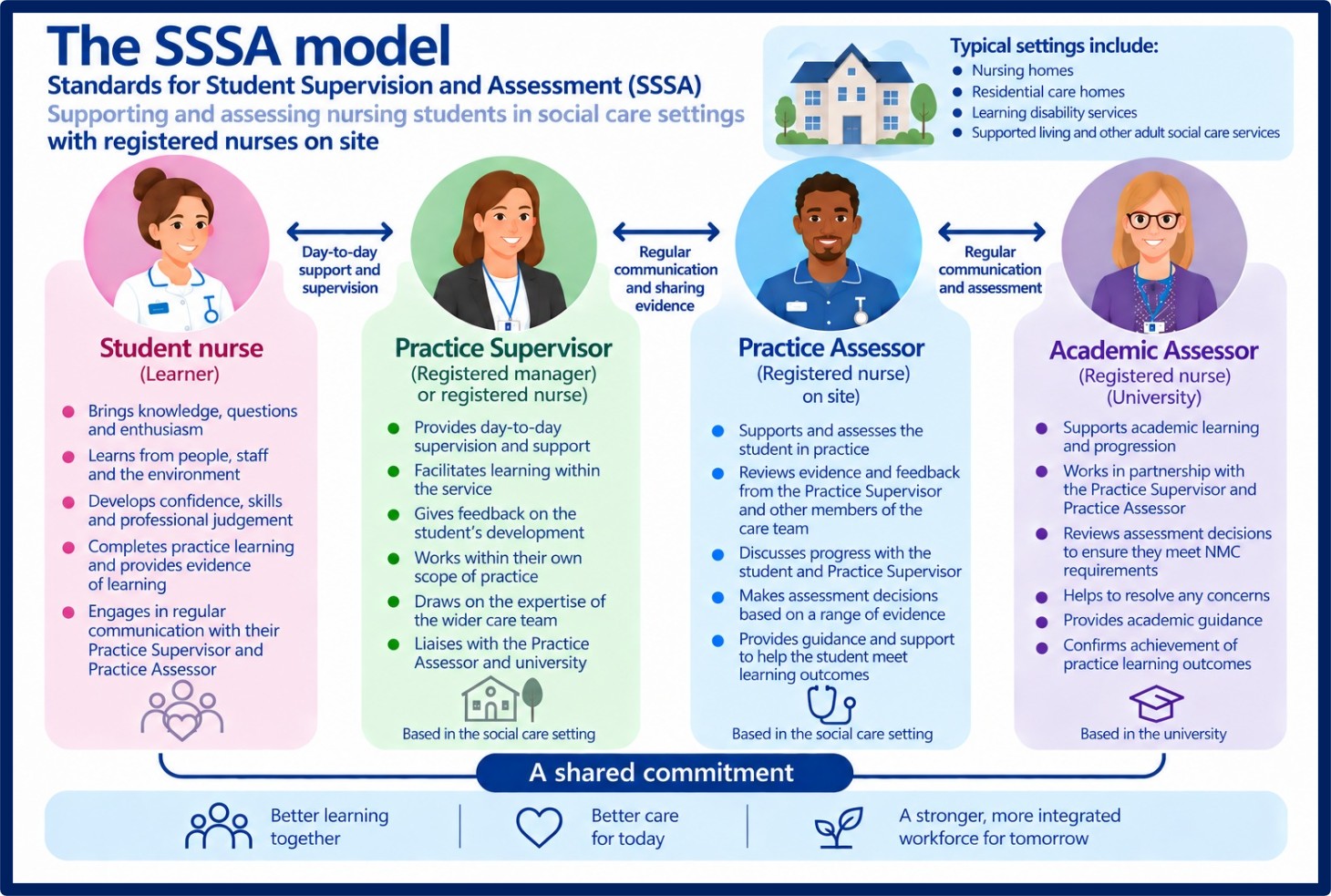
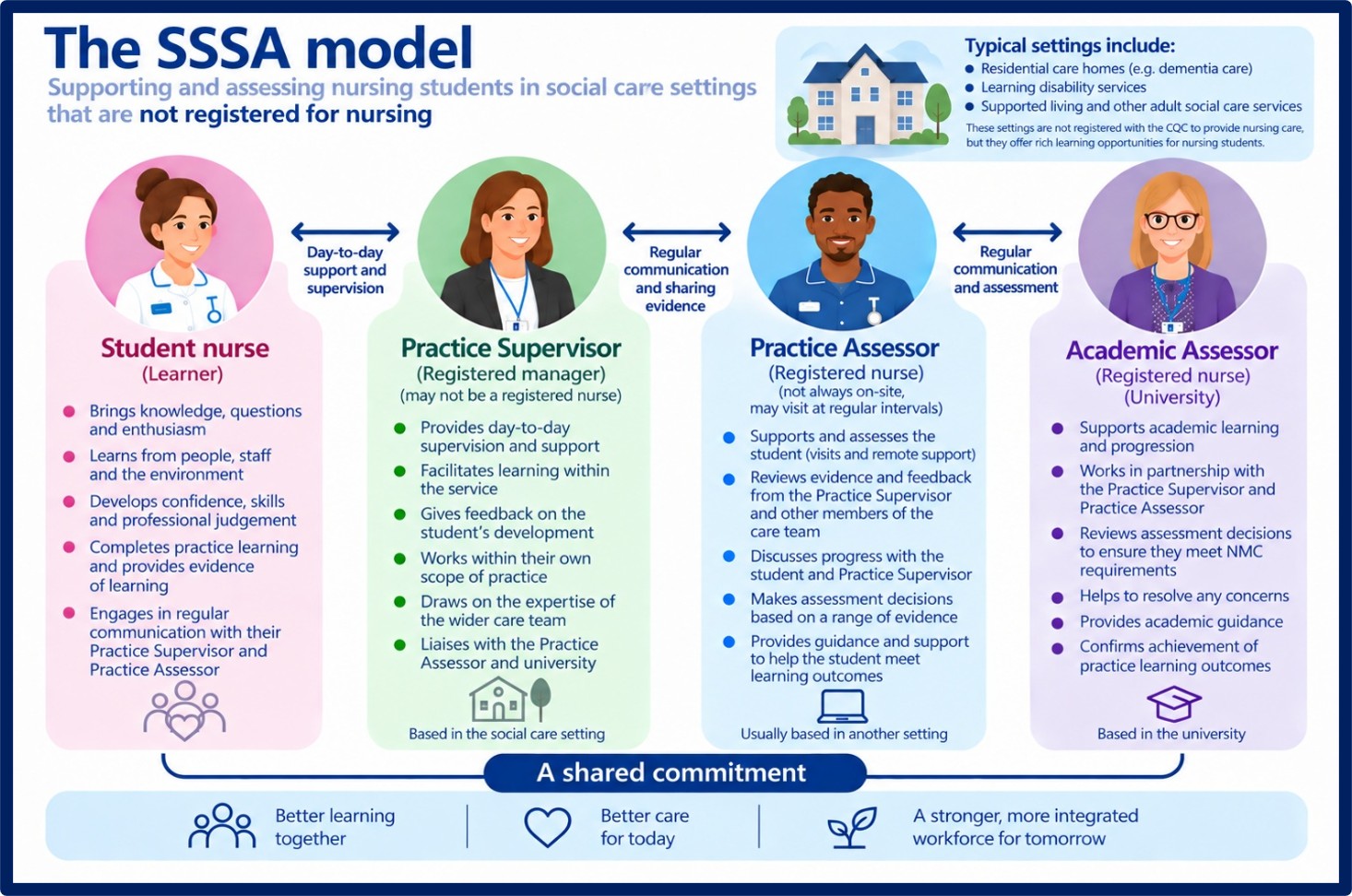
At the University of Exeter, we have developed this practice model with (non-nursing) residential care homes and supporting living settings, where an appropriately prepared CQC-registered manager can act as a student’s practice supervisor. This model includes working with a registered nurse practice assessor who supports the placement indirectly and a university academic assessor who oversees the assessment processes.
The manager is not being asked to become a nurse or work beyond their competence. They supervise learning, provide feedback and share observations with the practice assessor. Students also learn from the wider care team. One care worker reflected, ‘I loved working with the student. They said they learnt a lot from me about personal care and the attention to detail that is so important.’
Learning where people live their lives
Students see how long-term conditions, frailty, dementia, learning disabilities and complex needs interact with relationships, routines and what matters to the person. They discover the value of knowing someone well. ‘They’re just not themselves today’ can be an important sign of deterioration.
One student reflected, ‘I wasn’t sure what to expect but I learnt that people don’t go to social care to die – they go to live longer and better and have so much fun! I learnt about mental capacity, end of life medication, wound care, care planning and risk assessments, and how to link them all together to provide truly person-centred care.’
Students also experience multidisciplinary working from the social care side and discover the skill and autonomy involved in delivering complex care without a doctor immediately available. ‘The staff were so skilled and working autonomously. There were no doctors around. I didn’t realise how complex it could be.’
Seeing care from the receiving end changes how students understand hospital discharge. One student saw a person arrive at a care home for six weeks’ respite before returning home. They had three days of antibiotics left to take but the medication had not arrived. An out-of-hours doctor issued a prescription to a late-opening pharmacy and a member of the night staff collected it on their way to work.
The student realised that a care home cannot simply walk down the corridor to obtain missing medication. The experience showed why clear discharge information, medicines reconciliation and collaboration matter.
The experience can also shape the kind of nurse a student wants to become. One student reflected, ‘This experience has been transformative for me. It was like being a family member, so homely. I won’t rush anymore. This experience has really shown me what type of nurse I want to be.’
From opportunity to practical support
Since 2024, this work has also developed nationally. In 2025, I was commissioned to support the development of Skills for Care’s Supervising nursing students – RM resource. Designed for social care, it helps registered managers understand the practice supervisor role, NMC expectations, positive learning environments and the contribution of the wider team.
The resource sits alongside Skills for Care’s Strategy to enable social care placements for student nurses and nursing associates, which provides a framework for increasing high-quality practice learning opportunities across adult social care.
For registered managers who are not nurses, one message is particularly important: recognise the skills you already have. Victoria Meredith, Non-clinical Manager at Bay Court Nursing Home, explains, ‘Initially, I had some reservations about whether I would be able to provide the right level of support and understanding, but these concerns reduced as I gained confidence and worked closely with the student and their university assessor.’
Working together to assess students
Indirect practice assessment helps make placements possible in settings without registered nurses. Tracey, one of our registered nurse practice assessors who supports placements indirectly, explains, ‘I communicate regularly with the practice supervisor and academic assessor. I meet the student up to three times during their eight-week placement, sometimes more if needed, and we can have Teams meetings in between, so there is good contact.’
Through visits, remote contact and feedback from the practice supervisor and wider team, the practice assessor can make informed assessment decisions without being based in the setting every day. So, ‘We don’t employ nurses, therefore we can’t host nursing students’ does not have to be the end of the conversation.
Bridging the gap
As our social care placement work grew, I realised that developing opportunities with individual providers was only part of the answer. We also needed to bring people across health, social care and education together to share learning, tackle barriers and develop new approaches.
I therefore founded the University of Exeter’s Bridging the Gap – Re-imagining Community-Based Practice Learning: Inspiring Change initiative. It brings partners together to develop community-based practice learning models that can be shared, adapted and sustained across organisations and regions.
The aim is to establish social care providers as education partners in preparing the future nursing workforce. At the University of Exeter, all our students can now expect a placement in social care as part of their practice journey.
Providers interested in hosting student nurses can contact their local university’s nursing programme or practice learning team to discuss opportunities and the support available. I remain convinced that some of the most important things future nurses need to learn are already happening in social care. We just need to open the door and let them see it.
Frequently asked questions and answers
Q: We are a group of residential care homes without nursing but we employ a clinical lead who is a registered nurse. Can they be the practice assessor?
A: Yes. Your clinical lead can undertake the practice assessor role, provided they are appropriately prepared and the arrangement is agreed with the university. The practice assessor does not need to be with the student throughout their placement.
In this model, the CQC-registered manager acts as the practice supervisor, providing day-to-day supervision and feedback. The clinical lead, as the registered nurse practice assessor, maintains regular contact with the student and practice supervisor, reviews evidence of learning and makes assessment decisions.
Q: We are a small home supporting people with autism and learning disabilities and we do not employ registered nurses. Can we host a student nurse?
A: Yes. Your CQC-registered manager could act as the practice supervisor, supported by an indirect practice assessor who is a registered nurse arranged by the university.
Q: We are a domiciliary care provider with a CQC-registered manager. Can we support student nurses?
A: Yes. As above, your CQC-registered manager could act as the practice supervisor, supported by an indirect practice assessor who is a registered nurse arranged by the university.
Q: We are a nursing home. We employ registered nurses and our registered manager is also a nurse. How would this work?
A: An appropriately prepared registered nurse or the CQC-registered manager can act as the practice supervisor, providing day-to-day supervision and feedback. An appropriately prepared registered nurse within the home (including the CQC registered manager), who is not the student’s practice supervisor, can act as the practice assessor, reviewing evidence of learning and making assessment decisions.
Q: Is there funding available for hosting student nurses?
A: Yes. Eligible placement providers in England may receive an NHS England clinical placement tariff for hosting student nurses. This funding is intended to support the costs associated with providing practice learning, including supervision and the learning environment. The amount and payment arrangements depend on the placement and the applicable tariff rules.
Your university’s practice learning team can explain whether your service is eligible, how the funding works and what arrangements need to be in place before a student starts. You do not need to be an NHS organisation to ask about placement funding. If you are considering hosting student nurses, raise the tariff with your university when you first discuss the placement.
To read Cathy’s 2024 feature on nursing education, click here. Then, share your thoughts on Cathy’s latest feature by leaving a comment below.
Cathy Rant is Clinical Practice Lead at the University of Exeter’s Academy of Nursing. Email: [email protected] Linkedin: @University-of-Exeter