By Sara Livadeas | December 7, 2023
Last Updated on December 7, 2023
When former Chief Executive Sara Livadeas secured a casual job working in the kitchen of her local care home, she didn’t expect to experience such a range of emotions. Some moments were positively uplifting but she also experienced feelings of loss. In this week’s CMM blog, Sara shares what lessons can be learned to strengthen employee retention.
When I got a job working the afternoon shift in a care home kitchen, I thought I might pick up some recipe ideas, but I had no idea that I would learn so much about altruism, love and death. As a former Chief Executive of a care home group, I regularly visited our kitchens and admired the dedication of the chefs, cooks and kitchen assistants and their skill in producing appetising food for a range of needs. When I went freelance, I wanted to broaden my horizons. Quite by chance, while scrolling through my local internet job board I came across an advert:
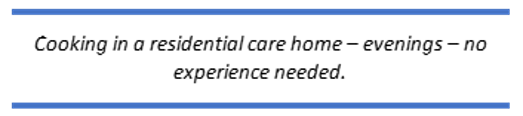
I thought, why not? I like cooking and I like older people. I applied for the job on a Saturday and by Sunday I was working my first shift in the home, guided by Jamie, who showed me how to do everything. I shadowed him for three days and then I was on my own. I was on my feet continuously for each four-hour shift, starting at 4pm and finishing at 8pm. In the beginning, it was stressful. The main challenge was keeping to time. Serving dinner to forty people simultaneously, making sure food was served hot, crispy chips, no soggy salads with the dressing added too soon and nothing prepared too early (unless it could be refrigerated), was difficult.
Freshly prepared food
The residents ate their main meal at lunchtime, but I still served up three courses each evening. Soup with freshly baked bread, a hot main course such as chilli, cauliflower cheese or cottage pie, cooked earlier by the chef, a different salad each day or a sandwich. If scampi and chips or baked potatoes were on the menu, it was down to me to cook. I had all sorts of personal choices to cater for – white or brown bread, vegetarian diets, pescatarians, people needing pureed food and so on. And that was without individuals requesting something different in the moment – fish instead of cold meat with their salad, a freshly cooked omelette, or a cheeseboard for dessert. The abundance of choice was great for the residents, but I did see a lot of waste.

And then it came to the trays. Every day about ten people chose to eat their evening meal in their bedroom. They too made menu choices and expressed personal preferences. Getting the trays right required really good communication with the carers and eventually, I mastered it, although I tried not to panic when we had an outbreak of COVID-19 in the home and I arrived to find the number of people eating in their room had risen to twenty. Jo Bosner’s Care Home Bedroom Mealtime Experience Checklist gives guidance on supporting people who eat in their rooms.
A demanding role
Once I had learnt the job the stress reduced, and I started enjoying myself. There was a routine to follow: On arrival check and count food choices. Keep on top of the ‘teatime’ washing up. Prepare the salads, sandwiches and fruit salad. Make or defrost the dessert. Who knew how complicated banana custard can be when you want to offer it in thirty individual glasses looking perfect and without it running down the side of the glass.
Serving the meal was a joint effort between myself and the care workers. We served people sitting at tables of four together, restaurant style. Some people required assistance to eat. One woman, Sheila, was at the ‘end of life’ and needed all her food to be pureed. She and I would discuss what she wanted to eat before each meal. The carers were clear, we do not need to worry about nutrition or a balanced diet now, this is all about Sheila enjoying her food.
Once the food was served the washing up began. It took ages to clear everything, wash it, put it away, clean the kitchen, record all the temperatures, put the rubbish out and sadly, lock the fridges. This was the loneliest part of the shift, when everyone else had drifted off and I was left alone in the kitchen cleaning up.

The care workers accepted me into their team without much ado. Although the tattooed de facto ‘Boss’ carer, Jackie, one day took issue with whose job it was to set the tables. ‘Who told you that it was the carer’s job to set the tables?’, she asked. ‘I can’t remember’, I replied. ‘Did Jamie say it was the carer’s job?’, she asked. ‘I’m not getting involved’, I said. Eventually, she gave up trying to pick a fight with me and we became best of friends.
Caring for carers
One of the most enjoyable aspects of the role was making sandwiches for the care teams to eat during their break. ‘You spoil us’ they would say. Their interactions with residents were consistently respectful and kind and it wasn’t clear to me who was looking after them.

Occasionally, one of them would ask if they could eat a portion of the main meal and I found myself in trouble with the Chef when he found out that I had allowed this. ‘They have their food’, he said. I was baffled by this attitude. Permitting care workers to help themselves to the occasional bowl of chilli could make all the difference in retaining these low-paid workers. Especially when so much food was thrown away anyway each day.
The carers were not particularly interested in me or my experience. It reminds me of Barbara Ehrenreich’s book ‘Nickel and Dimed’ about low-paid work in America, where the author found that her new colleagues were much more interested in whether she could work next Tuesday than the fact that she was an undercover journalist, the carers did not bat an eyelid if I told them I used to run care homes.
The reality of the role
Sadly, the Registered Manager was even less interested in what I was giving the residents at supper time. Not once did she come to see me, even though she was present in the home. The Quality Manager did come at the beginning to make sure that I was offering residents choice, which I found encouraging. The most disappointing realisation was that my manager was not interested in me either. The catering was externalised to a catering company. When I was interviewed on the phone, I offered up my DBS and asked for training in food hygiene (an online course costing all of £15). My employer never asked to see my DBS and the course did not materialise. After a week or two I was asked to fill in an application form. No references were taken up. I found it very disheartening when my boss came to see me but only stayed for five minutes. He never once said ‘thank you’ for my work or showed any interest in my ideas (to reduce waste or elicit residents’ feedback). Not the best way to retain employees.
The more alarming revelation involved recording. One evening Jamie dropped by to see how I was getting on and asked to see the list of tasks completed at the end of each shift, such as ‘floor mopped, temperatures checked, food ordered’. He looked at the list and said:
‘Just tick all of them.’
‘I can’t tick them, I haven’t done them all’, I replied.
‘Just tick all of them’, he repeated.
‘I can’t, that would be falsifying records.’
There was a very long pause before the slightly bemused Jamie finally confessed…
‘I’ve never read the list. I just tick them all.’
And he’d been doing this for four years!
A special connection
There is something very special about cooking for and feeding another human being. As every parent knows, feeding your family is fundamental to feelings of wellbeing. Food is more than social support, it’s something you need to survive. Cooking for another person is an act of altruism, making people feel happy and connected to others. In many cultures, hospitality revolves around food. I know from my own experience growing up in Greece you cannot have a visitor in your home without offering them a drink and something to eat. It is considered extremely rude not to do so. Alleviating hunger and serving others by providing food is a repeated theme in Christian scripture and in Islam. During the feast of Ramadan for example, Muslims are encouraged to feed each other at night. These altruistic acts are as important for the benefactor as the person receiving them.
Despite understanding this I did not anticipate the strength of connection I would feel not just to the people I was cooking for in the dining room, but for the people I never met because they ate in their rooms. One woman, Janet, who was receiving end of life care, had her food delivered on a tray. When I arrived at work one day to find that Janet’s name had been unceremoniously crossed off the list of food choices I was genuinely moved. No one told me that she had died. It didn’t cross anyone’s mind that I might feel upset. Talking to the care workers about their experience of loss, one said:
‘It happens so often you get used to it. I don’t have time to think about it I am so busy looking after the needs of the next person who is still alive. Maybe one day when I stop working, I will sit down and think about it all.’
I couldn’t help thinking about the impact of these ‘micro-bereavements’ on the wellbeing of the care teams. Once again, I wondered about retention of the workers who care for others and yet their employers seem to care so little about them. Whether they needed a debrief following a bereavement, a warm bowl of chilli or a plain and simple ‘Thank you,’ it was not obviously forthcoming.
During my time in the kitchen, I had seen first-hand the importance of valuing catering staff. Perhaps it’s stating the obvious but taking an interest in their work, listening to their ideas, providing training and showing appreciation will assist with employee retention. My experience in the home was overwhelmingly positive. Seeing the quality of food being served and witnessing the gratitude of residents for such simple pleasures such as a glass of favourite wine or a cheeseboard was uplifting and made the whole experience worthwhile.