Home-based support and care play a vital role in enabling us all to live well at home and flourish in our communities. Investing in support and care at home helps to prevent admission to more expensive settings of care, such as care homes and hospitals. Available homecare also enables people to return home from hospital safely. It makes little sense to neglect people in the community, wait for a crisis, then rely on expensive and limited critical care services. Regrettably, though, this is the UK’s current health and care strategy, and evidence suggests it is failing.
In July 2022, the number of deaths in England and Wales was over 1,000 per week above the five-year average in private homes, hospitals and care homes. Ambulance response times across all incident types increased in the latest month: in June 2022, one in 10 patients waited over one hour 54 minutes for a Category 2 (emergency) ambulance.
In June 2022, 28% of people attending A&E spent more than four hours from arrival to admission, transfer or discharge. Performance against the two-month cancer waiting time target is the worst on record. In May 2022, the proportion of patients who waited less than two months from an urgent GP referral to first treatment for cancer fell to 62%, the lowest recorded level. The elective care waiting list continues to grow; as of May 2022, 6.6 million patients were waiting for planned hospital treatment.
Furthermore, the UK ranks among the highest for rates of hospital admission in the Organisation for Economic Co-operation and Development for asthma and chronic obstructive pulmonary disease, both of which are considered largely treatable within primary care.
NHS leaders have suggested that the unsustainable pressure on health and care services is driven strongly, though not exclusively, by severe capacity challenges affecting social care. This is unsurprising given that investment in homecare is less than 4% of that in the NHS – most of which is directed at hospitals.

Demand for homecare is outstripping supply. The Association of Directors of Adult Social Services reported in May 2022 that hours of homecare delivered had increased by 16% over the last year. In the same period, though, hours of homecare commissioned but undelivered increased from 286,000 to over 2.2 million.
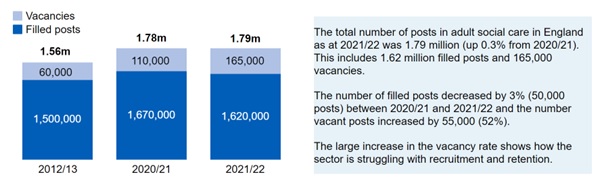
Data published by Skills for Care in July 2022, shows that the number of filled posts in adult social care fell from 1,670,000 in 2020/21 to 1,620,000 in 2021/22. In homecare, vacancies in 2020/21 were an estimated 52,000 (9.3%) and have increased to 75,000 (13.2%) in 2021/22. So, both recruitment and retention are declining.
Poor pay and terms and conditions of employment have long been problems for the homecare workforce, particularly in the state-funded part of the sector which represents 70% of the whole. These stem from inadequate funding by central Government and poor practices in commissioning and purchase of homecare by public sector organisations. In recent years, the homecare sector has also been adversely affected by Brexit, COVID-19, and now international conflict. Tightening of labour markets, pressure on supply chains and rising energy costs are fuelling inflation, which is placing further pressure on low-paid workers and their employers.
To make matters worse, many homecare workers are now not being paid or are receiving only Statutory Sick Pay (£99.35 per week) whilst isolating after a positive COVID-19
test, following removal of the Infection Control and Testing Fund by the Government. Almost half of homecare workers are on zero-hour contracts due to zero-hour purchase of homecare by councils, so they are paid only for hours worked.
A Homecare Association survey on fuel costs indicated that many homecare workers are also struggling to afford fuel for their cars. Government statistics show that fuel prices have risen by 46-48% in a year, leading to an unfunded additional cost of £107m for fuel.
Responses from 627 homecare providers, representing approximately 101,170 care workers and 146,100 care recipients, indicated that over half of care workers have asked for an increase in mileage rate, while just over a fifth added that care workers had either given notice, intended to look for work elsewhere or had already done so because they cannot afford to put fuel in their cars. Our research indicates that most care workers are paid mileage rates of 30p or lower, with many receiving only 10p per mile, in contrast to NHS mileage rates of 54p.
We continue to urge Ministers to:
- Pay for a temporary fuel allowance for homecare.
- Reinstate emergency COVID-19 funding for social care to enable care workers to receive full sick pay whilst
- Invest in homecare so we can pay care workers fairly, build capacity and reduce unmet need, recognising that NHS performance is critically dependent on social care.
Demand for care at home continues to outstrip supply, while adult social care budgets continue to be squeezed by central Government after years of underfunding.
Heart-breaking situations like this are the result. Here at Ashridge Home Care, we are continuing to call on the government to recognise the worth of the care industry and how it can help alleviate pressure on the NHS, invest adequately in home care so we can pay care professionals fairly and reduce unmet need.
Thank you for sharing your experience with CMM. We will continue to share the sector’s calls to Government and await updates from DHSC.