
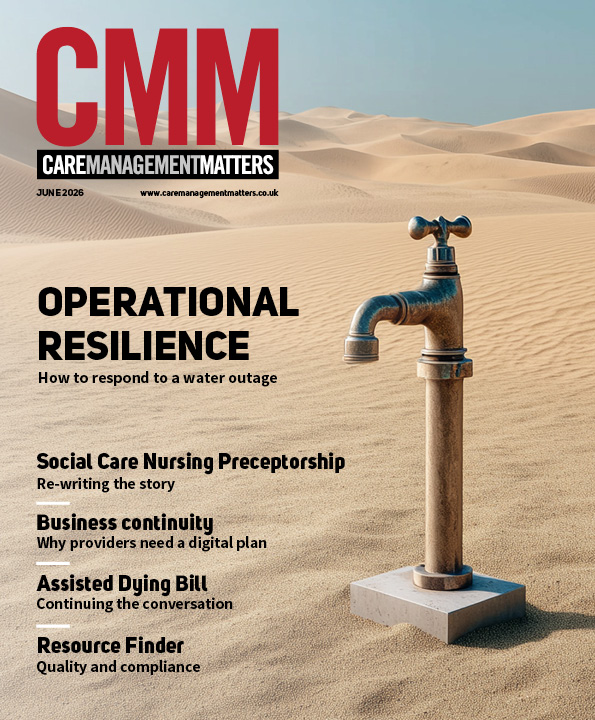
Jason Denny: We first knew something was wrong on the Saturday afternoon when staff turned on the taps and nothing came out. The news was reporting a chemical problem at the local treatment works, leading to low pressure and water loss. Some of our staff went out and bought bottled water from the supermarket as obviously our residents’ safety and wellbeing was our top priority.
At Milward House, we look after 22 older adults, some with dementia, and there are nine residents in the independent flats next door who fall under our organisation, Pilgrims’ Friend Society. That meant overall there were 31 older adults in a potentially very vulnerable situation.
Lacking clarity
Despite the seriousness of the problem, no one got in touch with us – neither the water company, nor the local resilience forum, nor the commissioners, nor any of the relevant local health authorities. We were left to follow the news and check for updates online ourselves. Initially, it seemed the problem would be temporary. However, on Sunday morning there was still no water, and estimates for it to be restored were revised to Monday. The uncertainty around the timescale made it impossible to plan.
In the face of this challenge, we did everything we could to ensure life continued as normally as possible. This meant more supermarket runs for bottled water and boiling kettles for everything from cups of tea to strip washes and cleaning commodes. One of our carers had an electric urn which she brought in from home and that was a big help in heating water.
The job in hand
Monday morning rolled around and there was still no water, and still no word from the authorities. Stations for bottled water had been set up locally, but the queues were at least an hour and a half and we did not have the time. Our Business Manager, Sid, found a number that we could call to have water delivered, so we calculated how much we thought we needed and put in our order.
However, when the water was delivered it came on a big articulated lorry. This posed a problem for us; we only have a small car park with a narrow drive, and the lorry could not get in. The pallets of water bottles were therefore left on the other side of a busy road, and it took four team members 40 minutes to bring them all in, in the rain, no less. Still, there was good camaraderie and teamwork, as everyone got on with the job in hand.
Managing disruption
We thought that by Tuesday it would be back to normal, but no such luck. It was at this point the local media got in touch with us. This gave us the opportunity to be a voice for our older residents and social care more broadly, highlighting how those with dementia especially can suffer when normal routines are disrupted as they rely on regularity, such as being able to have a bath or shower on a certain day.
With the water outage entering its fifth day on Wednesday, we finally got a call from our local authority. I would describe it as a courtesy call, rather than a substantive offer of help. I was able to report that we were managing, thanks in large part to our brilliant staff. I think the fact that many of them had worked through the pandemic helped – they had that resilience to draw on.
We had no staff absences during that entire week, which bears testament to their ability to work through a crisis. Thanks to their efforts, we were able to keep a full programme of activities running, and welcome in volunteers and visitors, ensuring that our residents did not miss out and were kept safe and infection free.
Responding to challenges
While we were managing to keep the kitchen running and maintain hygiene, not being able to use our laundry was becoming a challenge. As much as possible, residents had been wearing the same clothes, but things were starting to pile up, including bed sheets. Our staff took some laundry to laundrettes, and relatives offered help along with people who saw us on the news channels, but they could only do that piecemeal.
On Wednesday evening, we had another lorry delivery of water. It came around 9.00pm when there are fewer staff at the home and those who are there at that time cannot leave the floor. Sid, who lives locally, ended up coming in with his two sons to ensure that the bottles were carried in safely.
Returning to normal
By Thursday, the water finally came back on, with the precaution of a 10-day boil notice in place. However, due to the outage, several airlocks had developed in our pipes so some of the downstairs taps still did not work and the toilets did not flush. We had to call out a plumber at our own expense. Fortunately, as we are part of a larger organisation, we had the resources to cover this, but I think a smaller independent care home could really struggle.
On the Friday, we received a visit from the county council – again more of a courtesy visit than a practical offer of help. The next few days were busy playing catch-up with the laundry. Issues with air locks in the pipes persisted and it was not until about a fortnight later that everything was fully restored.
Future planning
Following the incident, we have put in place some measures should the same thing happen again. This has included keeping one day’s supply of bottled water on site, roughly 2,000 litres. We are fortunate that we have space to store this. We have also identified some external laundry services we could call upon.
Since the outage, I have had the opportunity to meet with Government officials to share our experience, drawing attention to just how unsupported we in the care sector are. If a hospital were left without water, I would expect other local services to step in and help. So why, as a care home, are we left high and dry? At the very least, a risk assessment might have allowed us to use water for sanitation purposes rather than simply a blanket decision to cut off the water supply for six days.
Engaging Government to facilitate change
Professor Vic Rayner OBE: Jason Denny asks a very salient question at the end of his reflection. How could a care home plus adjoining flats, housing 31 vulnerable, older adults, many living with dementia, be left without running water for six days?
As soon as NCF colleagues and I were made aware of the outage, we made it our mission to find answers for Pilgrims’ Friend Society and endeavour to ensure a similar incident does not happen again to any organisation providing vital care and support to the most vulnerable people in our communities.
Demonstrating the supportive way in which our not-for-profit provider members collaborate, Pilgrims’ Friend Society kindly shared a written case study for us to circulate around our membership so they could benefit from lessons learned and Jason’s recommendations.
The case study was also shared with the Operational Resilience team within the Department of Health and Social Care (DHSC) and a meeting swiftly arranged with officials, where Jason and Adrian Topping, Assistant Director of Operations at Pilgrims’ Friend Society, could explain the experience on the ground.
From that meeting, DHSC has embraced the chance to learn, which has been helpful. It has facilitated further opportunities to share the case study with water companies, liaising with the UK Health Security Agency (UKHSA) to understand how it would engage with care providers during a similar incident and working with the Ministry of Housing, Communities and Local Government to look at current planning requirement for care homes and how resilience is taken into account.
It is clear from the account that the team at Milward House did an incredible job to mitigate these risks, but ensuring that the wrap-around response better recognises the complexity of support offered by care providers, and the need for proactive engagement from all parties from day one onwards is a lesson that must be learned.
Follow-up meetings took place in March, including the Adult Social Care Operational Resilience Forum, where I had the opportunity to raise the case study and the challenges it exposed around communication, logistics and accountability. I also identified that the incident highlighted the importance of clear engagement between providers, commissioners and water companies to understand practicalities such as delivery and storage of water and access to care settings.
The case study has been incredibly helpful in identifying the unequivocal impact of water outage on people drawing on care and support and the workforce, and I am very grateful to NCF members like Pilgrims’ Friend Society who are prepared to spend time and energy sharing their experience so that others do not have to face this challenge alone.
Has your setting experienced a similar outage? What was the response? Visit the CMM website and comment on this feature or join the conversation to share your experience.
Jason Denny is Registered Care Manager at Milward House.
Email: [email protected] LinkedIn: @Jason-Denny
Professor Vic Rayner OBE is Chief Executive Officer at the National Care Forum (NCF).
Email: [email protected] LinkedIn: @National-Care-Forum