

CMM meets Team EVA
CMM: How does your product work?
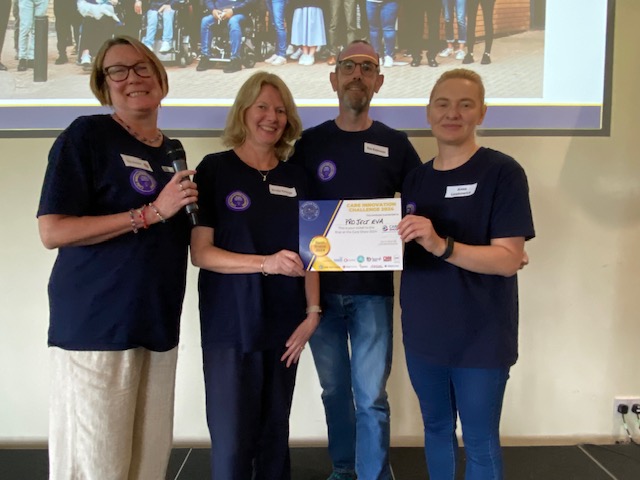
Tim: EVA is a phone chat assistant who will call clients and patients and walk them through some questions about their care needs. It’s for low-care needs, asking questions about taking medication, general physical health, mental health, challenges and so on.
It has a discussion and tries to alleviate some loneliness and isolation problems of people living at home but creates reports for carers so that they have a general report history for care managers.
It solves problems for three different levels – organisation, individual carers and people in receipt of care. We’ve seen so many other opportunities for different scenarios too.
CMM: How did you find the process of teaming up during the weekend?
Tim: I came into the weekend with a technical idea, but I didn’t have a background in care. There were lots of gaps in my understanding so I’m grateful for Kirsty and Anna. They’ve been suggesting great questions EVA could ask I would never have considered. Their experiences of being on the front line, the sort of questions to ask and how to deliver compassionate care are just making things so much better.
Kirsty: My background is in care and support and I’m aware of the issues within the sector. I met with Tim and thought his idea was really good. I could see that being used in the workplace and other scenarios. It’s a good skills match between the team.
Anna: I came with a passion for care, innovation and making a difference. Hearing Tim’s idea, there’s so much potential. As much as he came with his idea based on his personal experience, it has so many applications. That passion of ours shines through Tim’s idea.
CMM: Did you receive any advice from mentors?
Tim: A lot of the discussions were about framing the pitch. We knew what was important, but it was how to deliver that message effectively.
Anna: It was about how to showcase it and ask what the selling point is. It’s that connection that brings something different. We don’t want to expand too much on EVA yet because I think it needs to be just consistent at the moment. We all feel that if we concentrate on one area of use, then we can start exploring different opportunities.
CMM: How did you find the weekend overall?
Kirsty: It was really good just to step out of your comfort zone and do something completely different. That coupled with the challenges in the care sector, you feel like you’ve been useful. It was interesting to meet different people and hear about all their ideas because you don’t do that in the normal workplace.
Tim: I’m hugely grateful for the session and for the opportunity to connect with Anna and Kirsty for giving me their incredibly valuable and undervalued time to try and make things a bit better.
CMM: What would you like to highlight at the final?
Tim: We need clear engagement with people who can help us to bring this to a broader audience. We should clearly demonstrate the return on investment and potential benefits case for the solution. I’ve already had people reaching out to ask if EVA could help in different situations, so I think we’ve got an opportunity to land the message.
Anna: We can also show how the report will be generated following conversations with EVA, present what information she’s gathering and possibly expand on her knowledge and how she learned about someone she’s interacting with.
CMM meets Team Care Coach
CMM: What is your idea in a nutshell?
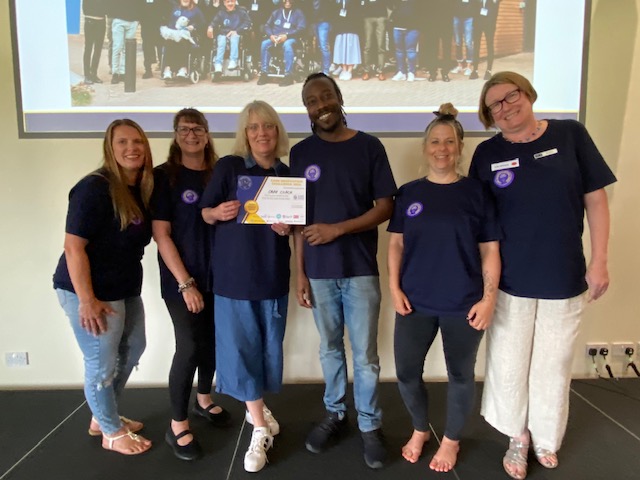
Sarah H: Care Coach is a care co-ordination app designed to link tasks, people, support and help for those with lower-level support needs. At Affinity Trust, we get a lot of referrals from people who only have very small care budgets we have to refuse for various reasons.
We want to develop a viable solution that enables us to start saying yes to those referrals that can lean into community assets and relational networks a person has. It might include some assistive tech or direct paid support from a PA or a support worker that our organisation employs. David has developed an app that enables people to co-ordinate care pools using their relational network.
CMM: How did you find coming together as a team on the day?
Sarah H: We got chatting to David and he was doing something similar to what we were looking for in tech innovation.
Sarah W: Without having the Challenge, I don’t know if our paths would have ever crossed. David has experience, both with family, but also as someone who is well versed in coming up with solutions that are new to our sector.
Sarah H: The whole process over the weekend was co-productive. It helped us to draw on our individual strengths and spot where our gaps in knowledge and understanding were. David brings his knowledge of technology and other areas of social care. When we teamed up, we came up with a brilliant solution and we’re excited about it.
CMM: Have you conducted any market research?
Sarah H: Elements of our idea are being addressed, but we haven’t seen anybody bringing the whole thing together as a model. Specifically for the learning disability part of the sector, I don’t think anybody’s doing anything like that. The people who are ageing are still looking after their sons or daughters and they’re going into crisis. So, they’re ending up with big packages when they aren’t needed which is making them more dependent.
CMM: How did you find the Challenge weekend?
Ruth: It’s quite out of my norm of a week, so it was nice doing something refreshing and completely different. It motivated me again. I found it useful and helpful, and it was great working with the team.
Sarah H: It’s valuable to be in a room together in a solution-focused atmosphere because we don’t get that very often as a team. It was really positive. You could feel the energy in the room because of the fast pace.
David: It was a great weekend overall. It encouraged cross-collaboration and was extremely powerful because Affinity brought so much knowledge of the commissioning process, the process of getting grants and other funding so it was quite eye-opening for me. Having this epiphany about wider adult social care was very useful for me.
CMM: What are you hoping to showcase at the final?
Sarah W: We all have a shared vision of engaging the audience. It’s a fantastic opportunity to push further for innovation in social care. We need more people doing more of this.
David: The Care Show also gives us an opportunity to draw attention to our solution with opportunities for collaboration and funding.
For the five finalists it all comes down to the next few weeks and the continued mentorship they will receive as they prepare for The Care Show at the Birmingham NEC on 9th and 10th October.
Follow @CareInnovHub and use #CareInnovationChallenge for updates.