
When we published our first set of Fee Rate Maps in March 2023, we had no idea that the positive response they generated would lead to them becoming an annual project that would play such a central role in guiding the focus of our work.
Our members and the wider learning disability social care sector told us that the maps made a real difference in negotiations with commissioners and that more realistic fee rate uplifts were secured as a result.
So, in December 2023 the ARC England Learning Disability and Autism Research Unit commissioned data visualisation experts Polimapper to begin sending the next round of Freedom of Information requests to all the local authorities in England and Wales, asking them about the rates they pay for learning disability and autism services.
Following feedback from the first year of the maps, we were able to extend the reach of the questions to local authorities. As well as asking about rates for supported living, residential services, domiciliary care and day services, we also asked about the services local authorities provide themselves, so that we can compare these with externally commissioned services.
We also asked about the time allowed for staff training and added some more detailed questions about day services. The reasons for this were twofold; firstly, day services are purchased differently from other services, and we wanted to ensure that the fee rate data works better for day services providers, and secondly, day services are faring least well in terms of fee uplifts across all learning disability service types.
You can see the results of our Freedom of Information requests in this year’s maps, which again contain data searchable by local authority and by constituency (increasingly useful as we move towards a general election).
Looking at the National Living Wage (NLW) rise over time in comparison with fee rate uplifts, we now have six years of data mapped in line graphs for each service type. As can be seen from the following graph for residential services, fee rates have failed to keep up with NLW increases and this illustrates the cumulative impact of year after year below inflation increases. This is particularly pertinent in supported living services, where staff wages and salaries can represent upwards of 85% of operating costs.
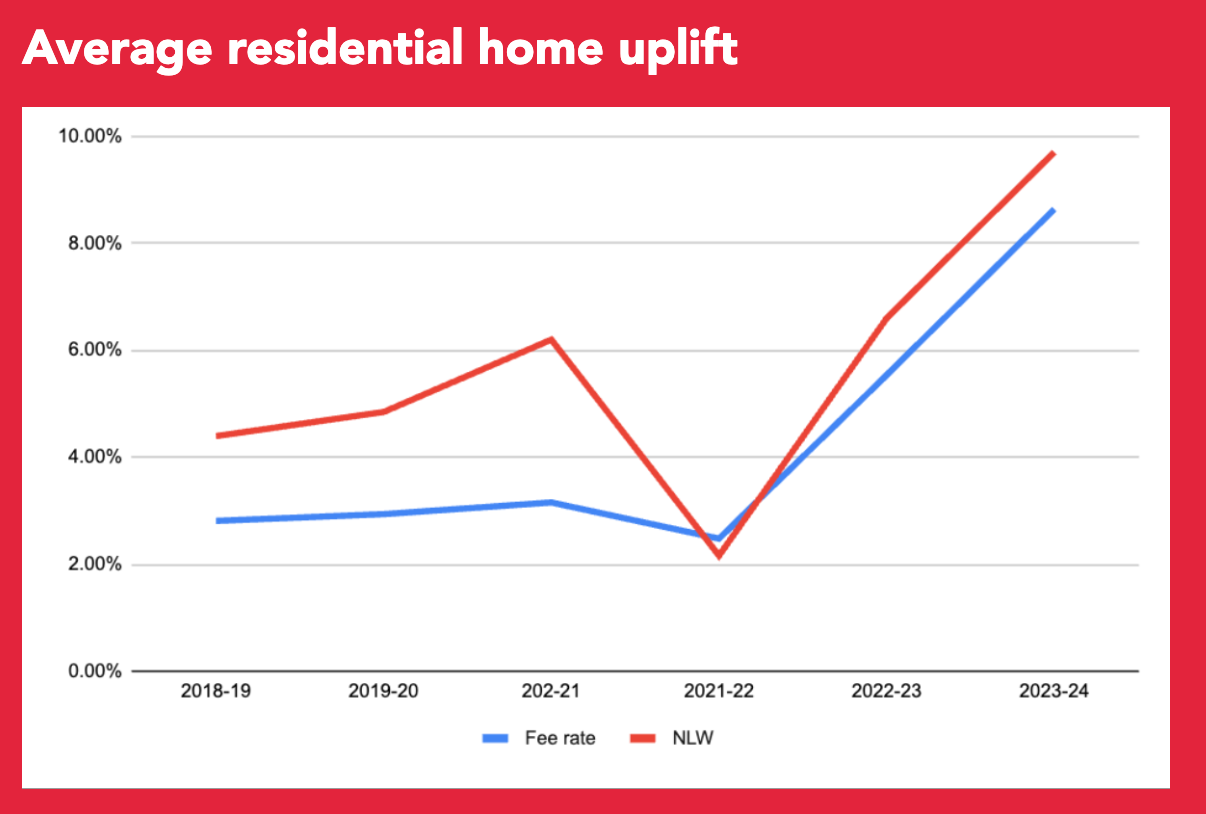
Local authorities need to be paying upwards of £22.95 per hour if providers are to meet their statutory requirement to pay their staff the NLW. For comparison, staff undertaking comparable roles in the NHS at Band 3 are paid, including allowances, an hourly rate of £27.80. The Unfair to Care 2024 report by our member Community Integrated Care has found a 36% pay gap between the average care worker and their equivalent role in the NHS.
Talking to our members and looking across the sector, we think a fee rate uplift for 2024-25 of at least 12% is required. Even this, however, does not begin to address the cumulative funding shortfall that year upon year of fee rate uplifts below inflation has created.
The current picture
If adult social care is invisible, then learning disability and autism service providers are towards the bottom of this hierarchy of invisibility.
CQC’s Market Oversight of adult social care has identified that it is specialist providers that are working under the worst of the financial pressures affecting social care services. This means learning disability and autism services. The urgent need to address this does not appear to have been understood by the Department for Health and Social Care.
We continue to see councils paying different rates for the same or similar services. This creates disparity and unfairness in the system. Our members are telling us that for 2024/25, councils are offering them fee rate uplifts in single figures, well below the 12% we have identified as the minimum required, and at a level which does not allow many of them to fulfil their statutory requirement to pay the NLW.
On top of that, we have even heard that some councils are suggesting to providers that they should use their reserves to continue to operate. Maintaining sensible operating reserves is necessary for an organisation, not only to ensure Charity Commission compliance, but because not doing so would be a dereliction of the duties of trustees and board members.
Clearly, it is inappropriate for a local authority to suggest that they could or should dictate a provider’s reserves policy. Learning disability support providers, whether charities or private sector, need to grow and invest in their staff, in IT and technological developments, and in bringing about the very best person-centred care for the people who draw on their support. To suggest that they should be subsidising their own services that the state has a duty to pay for is simply unacceptable in any sector, let alone one in which the voices of the people who rely on services are largely unheard.
The cumulative effect of fee rate uplifts that have failed to keep pace with inflation and other cost pressures is that providers are handing back unsustainable contracts and declining to accept packages of care that they are well placed to provide. We know that providers who are looking to expand their services are using the Fee Rate Maps to check rates in neighbouring counties to see if this expansion is viable, and we know of at least one occasion where a provider has decided not to offer services to a local authority who is shown to be paying inadequate fees.
It is also interesting to look at the role of day services. If learning disability and autism services are among the lowest in the social care ‘hierarchy of visibility’ then day services are the least visible service type overall. This is despite the fact that day services save local authorities huge amounts of money every year by, for example, enabling supported people to be looked after within their family home. As well as offering opportunities and activities for people who draw on support to live lives of choice and control, day services also provide a small amount of respite for unpaid family carers.
What price a life?
Although the latest LeDeR 2022 report found a drop in the number of avoidable deaths since 2021; 42% of deaths were still deemed ‘avoidable’ for people with a learning disability in 2022 compared to 50% in 2021.
The report also found that appropriate care was associated with reductions in premature death. Taking this into account, Government’s persistent underfunding of this essential care begins to appear as if they are simply turning their backs on the health of the learning disability community and potentially contributing to early deaths. The National Audit Office report, Reforming adult social care in England, backs up our view that the department is operating without a long-term social care plan.
Successful services run by our members improve people’s quality of life and support them to take the necessary steps towards an independent life. Moreover, they improve physical and mental health conditions and therefore alleviate pressure on overstretched NHS services. When we help and support individuals, their families and carers to pursue and achieve their goals in life, we are contributing to social change in our communities.
People with learning disabilities and autistic people are some of the most socially excluded in our society. Employment opportunities are scarce, they rarely live in their own homes or have a choice over who cares for them. However, at ARC England, along with our research partners, members and advocates, we believe that every individual has a right to a life lived with choice and control and in which their strengths and abilities are nurtured and celebrated.
We are therefore calling for Government to act quickly to stabilise the learning disability social care sector and for learning disability and autism services funding to be properly and robustly ring fenced thereafter.
Is your local authority paying a fair fee rate? Leave a comment on this article or join the conversation to share your thoughts.
Clive Parry is Director at ARC England. Email: [email protected] X: @ARCEngDirector